04 December, 2013

the Internet of Things

Chances are you’ve heard about the Internet of Things (IoT) or you will soon enough. The term carries a number of definitions. But in general, the IoT refers to uniquely identifiable objects, such as corporate assets or consumer goods, and their virtual representations in an Internet-like structure. In effect, these networked things become “smart objects” that can become part of the Internet and active participants in business processes. Current or potential examples of the IoT include a vast array of objects: fleets of trucks, medical equipment, vending machines, construction equipment, gas and electric meters, thermostats, household appliances, advertising display signs, and many others.

Enabling and driving the transformation to integrated computing is the move from isolated systems to Internet-enabled devices able to network and communicate with each other and the cloud. The Internet of Things (IoT), essentially a super network is being built by the convergence of increasingly connected devices, cloud economics, and the acceleration of big data analytics to extract value from data.

And it’s a major global trend that will increasingly impact CIOs so it’s important to monitor the scope and scale of IoT. Intel predicts that IoT will represent a 3.8 billion-device opportunity by 2015, and ABI Research thinks that IoT will be a 30-billion device opportunity by 2020. Cisco thinks that more than 50 billion things will be connected to the Internet by 2020. To put this number in perspective, that comes to about 7.1 devices for every person the United Nations projects to be living on our planet seven years from now.

Advances in microcontrollers, sensors, wireless connectivity and software are now enabling IoT. But as companies seek to capitalize on IoT they face challenges around fragmentation, interoperability, and intelligence at the edge of the network. It is important to address the fragmentation of IoT solutions to reduce the amount of required integration, and addressing interoperability means finding ways to effectively integrate legacy devices on the network with the growing number of new devices.

Companies increasingly will be operating in “smart buildings” with advanced HVAC systems that are connected to the rest of the corporate network. Many utility companies will be deploying Web-connected smart meters at customers’ facilities to allow for remote monitoring. Physical security is increasingly being tied to the company’s own network security, so that data from security cameras and authentication readers are coming under the purview of enterprise IT. Retailers such as WalMart, Target and Best Buy already use RFID and other tracking technologies to manage supply chain logistics. IoT is a natural next step.

Then there’s “operational technology”, where enterprise assets such as manufacturing equipment, fleet trucks, rail cars, even patient monitoring equipment in hospitals, become networked devices. Other examples of operational technology might include companies deploying vending machines that are connected to the Internet, so that they can be automatically restocked when certain items run low.

What will likely happen is a convergence of operational technology and IT. As these machines go onto the corporate network the CIO or the COO need to start talking together about what the future is going to look like when traditional IT stuff and OT stuff are overlapping on the network.
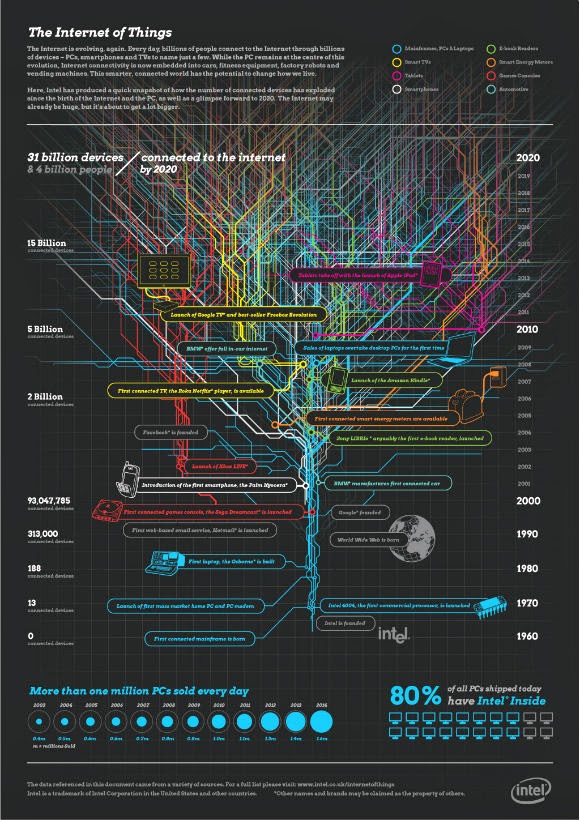
Furthermore, there are the data management issues. Getting the most value out of IoT requires an ability to manage data and gain insight from analyzing that data. If everything has the potential to provide some type of data stream, companies will need technologies to manage, store and analyze the data. While some organizations might be able to leverage existing information management tools, many will need to bring in new technologies designed to handle the real-time and large-scale nature of the IoT. Recent IT trends such as the move to the cloud and implementations of big data and analytics will likely come into play with the IoT, experts say.

Ensuring intelligence at the edge will provide the opportunity to address real-time needs by filtering massive amounts of data from an ever-increasing number of intelligent devices. CIOs that embrace IoT and monitor advancements in IoT devices will be well-positioned to capitalize on the analytical opportunities arising from the massive streams of real-time information that will become available to improve operations. Intelligent devices, need to funneled through intelligent gateway solutions, and the whole data stream is to be overseen by intelligent analytics. The computer industry via its usual pioneers is now focused on accelerating the development and deployment of intelligent devices, creating systems of systems by connecting legacy devices to the cloud and enabling end-to-end analytics to transform businesses across the globe.

With most of today’s networked devices based on legacy systems, the need to address interoperability instead of replacing all existing infrastructure is imperative. Layering in new technologies — such as intelligent gateways — into existing environments allows companies to maximize their infrastructure investments while acquiring the intelligence needed to drive next-generation design innovation. As businesses increasingly embrace IoT, they must first address the integration demands that come with connecting devices, the cloud, the datacenter, and all the other facets of IT.

06 November, 2013

surfing the Deep Web

The Deep Web (also called the Deepnet, the Invisible Web, the Undernet or the Hidden Web) is World Wide Web content that is not part of the Surface Web, which is indexed by standard search engines like Google. It should not be confused with the dark Internet, the computers that can no longer be reached via Internet, or with a Darknet distributed filesharing network, which could be classified as a smaller part of the Deep Web. [1] 

The Deep Web is a complex concept. It is essentially two categories of data. The first is basically any information that is not easy to obtain through standard searching, which could be Twitter or Facebook posts, links buried many layers down in a dynamic page, or results that sit so far down the standard search results that typical users will never find them. The second category is the larger of the two and represents a vast repository of information that is not accessible to standard search engines. It is comprised of content found in websites, databases, and other sources. Often it is only accessible through a custom query directed at individual websites, which cannot be accomplished by a simple “surface web” search. [2] Some of the more comprehensive search engines have written algorithms to search the deeper portions of the world wide web by attempting to find files such as .pdf, .docx, .xls, ppt, .ps. and others. These files are predominately used by businesses to communicate within their organization or to disseminate topical information and work product to customers and potential clients.

[Fig] the Deep Web size compared to the Surface Web size, taken from :

Traditional search engines create their indices by spidering or crawling surface Web pages. To be discovered, the page must be static and linked to other pages. Traditional search engines cannot "see" or retrieve content in the Deep Web ; those pages do not exist until they are created dynamically as the result of a specific search. Because traditional search engine crawlers can not probe beneath the surface, the deep Web has heretofore been hidden. The Deep Web is qualitatively different from the surface Web. Deep Web sources store their content in searchable databases that only produce results dynamically in response to a direct request. But a direct query is a "one at a time" laborious way to search.

Surface Web : Parts of the internet that can be found via link crawling techniques – meaning it is linked data and can be found via a link from the homepage of a domain; Google can find this data. Deep Web : Portions of the internet that cannot be accessed by a link crawling search engine like Google. The only way a user can access this portion of the internet is by doing a directed query into web search form to access content within a database that is not linked data. In layman’s terms, a search that is within a particular website. [7]

To put it in context, the Deep Web isn’t found in a single location. It consists of both structured and unstructured content ; a huge amount of which is found in databases. This content has often been compiled by experts, researchers, analysts and through automated processing systems at an array of institutions throughout the world. All of the content is housed in different systems, with different structures, at physical locations that can be as far apart as New York and Hong Kong. It’s almost impossible to measure the size of the Deep Web. While some early estimates put the size of the Deep Web at 4,000-5,000 times larger than surface web, the changing dynamic of how information is accessed and presented means that the Deep Web is growing exponentially and at a rate that defies quantification. [2]

“The Deep Web has existed for more than a decade but came under the spotlight last month after police shutdown the Silk Road website - the online marketplace dubbed the 'eBay of drugs' - and arrested its creator. But experts warn this has done next to nothing to stem the rising tide of such illicit online exchanges, which are already jostling to fill the gap now left in this unregulated virtual world. Meanwhile, even as the Silk Road was trundling to a halt, already hundreds of other websites were springing up in its place, peddling anything from drugs to stolen identities, illegal weapons to sickening child pornography and even explosives. In June it emerged one such site, called Atlantis, was even offering its wares in an advert posted on YouTube. Hiring a hitman has never been easier. Nor has purchasing cocaine or heroin, nor even viewing horrific child pornography. Such purchases are now so easy, in fact, that they can all be done from the comfort of one's home at the click of a button... and there's almost nothing the police can do about it.” [3]

However is the above hype all that justified ? There seems to be a grave misundestanding of what the Deep Web actually is and what information is accessible on the Internet through encryption procedures. All recent cases that have “shocked” reporters and users alike are reffering to TOR sites, ie sites that are not accessible through the standard search engines, but that happens because they are encrypted via the TOR protocol.

TOR (originally TOR, an acronym for The Onion Router, a usage now abandoned) is free software for enabling online anonymity. TOR directs Internet traffic through a free, worldwide, volunteer network consisting of more than four thousand relays to conceal a user's location or usage from anyone conducting network surveillance or traffic analysis. Using TOR makes it more difficult to trace Internet activity, including "visits to Web sites, online posts, instant messages, and other communication forms", back to the user and is intended to protect the personal privacy of users, as well as their freedom and ability to conduct confidential business by keeping their internet activities from being monitored. [4] Read the “history” section of the Wikipedia article and you will realise that TOR is neither secure, nor so much “independent” in nature as most believe. TOR is not “on the deep web”, as most people suggest.

While Tor is used by everyone from law enforcement to Syrian dissidents to protect valuable information, it is a double-edged sword. Many experts warn that groups ranging from the Russian mafia to international drug cartels are looking closely at the lessons learned from the Silk Road. It took the FBI more than two years of investigative work to find Ulbricht. They don’t have the resources to compete with Silicon Valley in hiring, or the tools—a long-hoped for modernization of the law governing online wiretapping is on ice in Congress thanks to Edward Snowden. [5]


“The so called Darknet is a part of the internet encrypted and partially hidden from indexing, but it still runs on the physical network infrastructure and uses the TCP and IP protocols for transmission and identification. Far more interesting is the new physical networks being created, using preexisting power, cable and telecommunication lines, with new data transfer and node id protocols. Totally separate networks using a multitude of unique languages and rules. Three primitive forms run in LA ,New york and possibly London. Inter- network communication is provided by translator servers, with local protocol knowledge.These will surly be the the real darknet of the not so distant future.” [3, comments page]

In your quest of surfing the Deep Web, you may try the following search companions, however be advised that they mostly deal with TOR sites. The article source offers also a comparison with regards to the performance of these search engines. [6]

Evil Wiki : Without a doubt, this is the single best entry point into the world of Tor. The well-maintained website provides an organized list of links to hidden services with explanations and even reviews. It’s not meant to be used as a search engine, but it often is.
TorSearch : A new search engine that has garnered some buzz in publications like VentureBeat. It operates in much the same way as Google, with a link-crawling spider that will forever build its arsenal.
Google : With proxy tools like Onion.to, Google actually crawls much of the Deep Web in a roundabout way. And because it’s so popular, it’s the first tool that almost anyone who hears about the Deep Web uses.
DuckDuckGo : Similar to Google but with one significant difference, DuckDuckGo offers anonymous search, a feature in keeping with Tor’s powers of anonymity. It’s no surprise that it’s popular among the Tor crowd.
Torch : An older Deep Web search engine, Torch has existed for a long time but little fanfare.
Hidden Wiki : The Hidden Wiki is a website that uses hidden services available through the Tor network. The site has a collection of links to other .onion sites, and encyclopedia articles in a wiki format.


Further reading :
Bergman, Michael K., White Paper, “The Deep Web: Surfacing Hidden Value”, http://quod.lib.umich.edu/cgi/t/text/text-idx?c=jep;view=text;rgn=main;idno=3336451.0007.104

13 October, 2013

the Human Brain Project has kicked-off

Understanding the human brain is one of the greatest challenges facing 21st century science. If we can rise to the challenge, we can gain profound insights into what makes us human, develop new treatments for brain disease and build revolutionary new computing technologies. Today, for the first time, modern information and communications technology (ICT) has brought these goals within sight. Today, the convergence between biology and ICT has reached a point at which it can turn the goal of understanding the human brain into a reality. It is this realization that motivates the Human Brain Project (HBP) ; an EU Flagship initiative in which over 80 partners will work together to realize a new "ICT-accelerated" vision for brain research and its applications.

In October 2013 the Human Brain Project's official kick-off was carried out during the HBP Summit held in Laussane. In addition to the meeting of scientists from the HBP's 80+ partner institutions, the programme included the first meeting of the HBP General Assembly, an international media event, an open-doors poster session for students, researchers, journalists and members of the general public, and a special dinner to celebrate the start of the HBP's 10-year enterprise.

The Human Brain Project is a ten-year project, consisting of a thirty-month ramp-up phase, funded under FP7, with support from a special flagship ERANET, and a ninety-month operational phase, to be funded under Horizon 2020. The project, which will have a total budget of over Euro 1 billion, is European-led with a strong element of international cooperation. The goal of the project is to build a completely new ICT infrastructure for neuroscience, and for brain-related research in medicine and computing, catalysing a global collaborative effort to understand the human brain and its diseases and ultimately to emulate its computational capabilities.


The proposed infrastructure will consist of six ICT-based research platforms, providing neuroscientists, medical researchers and technology developers with access to highly innovative tools and services that can radically accelerate the pace of their research. These will include a Neuroinformatics Platform, that links to other international initiatives, bringing together data and knowledge from neuroscientists around the world and making it available to the scientific community; a Brain Simulation Platform, that integrates this information in unifying computer models, allowing in silico experiments, impossible in the lab; a High Performance Computing Platform that provides the interactive supercomputing technology neuroscientists need for data-intensive modelling and simulations; a Medical Informatics Platform that federates clinical data from around the world, providing researchers with new mathematical tools to search for biological signatures of disease; a Neuromorphic Computing Platform that makes it possible to translate brain models into a new class of hardware devices and to test their applications; a Neurorobotics Platform, allowing neuroscience and industry researchers to experiment with virtual robots controlled by brain models developed in the project. The platforms are all based on previous pioneering work by the partners and will be available for internal testing within eighteen months of the start of the project. Within thirty months, the platforms will be open for use by the community, receiving continuous upgrades to their capabilities, for the duration of the project.

The HBP will trigger and drive a global, collaborative effort that uses the platforms to address fundamental issues in future neuroscience, future medicine and future computing. A significant and steadily growing proportion of the budget will be devoted to research by groups outside the original HBP Consortium, working on themes of their own choosing. The expected end results will include a new understanding of the brain and its diseases and radically new forms of ICT, that exploit this knowledge. The social economic and industrial impact is potentially enormous.

Federating more than 80 European and international research institutions, the Human Brain
Project is planned to last ten years (2013-2023). The cost is estimated at 1.19 billion euros.
The project will also associate some important North American and Japanese partners. It willbe coordinated at the Ecole Polytechnique Fédérale de Lausanne (EPFL) in Switzerland, byneuroscientist Henry Markram with co-directors Karlheinz Meier of Heidelberg University,
Germany, and Richard Frackowiak of Centre Hospitalier Universitaire Vaudois (CHUV) and the University of Lausanne (UNIL).

10 September, 2013

inside Musk's Hyperloop [an infographic]

On 12 Aug 2013, billionaire entrepreneur and inventor Elon Musk (founder of PayPal amongst else) unveiled the Alpha design of the Hyperloop, a high-speed train that promises travel at twice the speed of a commercial aircraft, transporting passengers from Los Angeles to San Francisco in just 30 minutes. Though Musk has been tight-lipped about the mechanics and design of the new system, plenty of enthusiasts across the web offered up their own guesses as to how this incredible 600 mph super train is supposed to work, adding ofcourse to the whole hype. Check out this infographic prior to the official release.

Elon Musk's vision for a futuristic Hyperloop transportation system concept involves sleek passenger capsules flying within a tube on a cushion of air. Solar panels along the entire length of the tube provide more power than needed to run the system. Capsules travel just under the speed of sound, at 760 mph (1,220 km/h). Passengers could travel from San Francisco to Los Angeles in 35 minutes. Streamlined capsules carrying 28 passengers each would depart from the station every few minutes. Passengers ride in pairs, with luggage stored at the front or rear of the capsule. The system is designed to keep accelerations on the passengers below 0.5 g (one-half the acceleration of Earth’s gravity). [1]

In Musk's own words : "When the California “high speed” rail was approved, I was quite disappointed, as I know many others were too. How could it be that the home of Silicon Valley and JPL – doing incredible things like indexing all the world’s knowledge and putting rovers on Mars – would build a bullet train that is both one of the most expensive per mile and one of the slowest in the world? Note, I am hedging my statement slightly by saying “one of”. The head of the California high speed rail project called me to complain that it wasn’t the very slowest bullet train nor the very most expensive per mile." Continue reading his rationale and reasoning here.


[Ref.] Wikipedia page on the Hyperloop : http://en.wikipedia.org/wiki/Hyperloop
Download the Hyperloop brief (in pdf format) from the location here.

29 May, 2013

the Drake equation

While working as a radio astronomer at the National Radio Astronomy Observatory in Green Bank, West Virginia, Dr. Frank Drake (currently on the Board of the SETI Institute) conceived an approach to bound the terms involved in estimating the number of technological civilizations that may exist in our galaxy. The Drake Equation, as it has become known, was first presented by Drake in 1961 and identifies specific factors thought to play a role in the development of such civilizations. Although there is no unique solution to this equation, it is a generally accepted tool used by the scientific community to examine these factors. [1]

In the BBC website under the "future" section, there is an excellent interactive infographic, that allows visitors to tamper and play with the factors of the equation, in order to yield different potential results, that help to quantify - if not to visualize - the question at hand. How many other civilizations are out there ?

It is not a rigorous equation, offering a wide range of possible answers. Instead it is more a tool used to help understand how many worlds might be out there and how those estimates change as missions like Kepler, a telescope that is currently searching for Earth-like planets, begin to discover more about our universe. Until ground-based observations, space telescopes and planet-roving robots uncover any tell-tale signs of life, what better way to speculate on how many intelligent alien civilizations may exist than to explore the universe with our interactive version of the equation. [2]


As many skeptics have pointed out, the Drake equation can give a very wide range of values, depending on the assumptions. It is essentially a very simple model that does not include potentially relevant parameters, and many changes and modifications to the equation have been proposed. [3]Criticism of the Drake equation follows mostly from the observation that several terms in the equation are largely or entirely based on conjecture. Star formation rates are on solid ground, and the incidence of planets has a sound experimental basis, but as we move from the left to right in the equation, estimating each succeeding factor becomes ever more speculative. The uncertainties revolve around our understanding of the evolution of life, intelligence, and civilization, not physics. No statistical estimates are possible for some of the parameters, where only one example is known. The net result is that equation cannot be used to draw firm conclusions of any kind, and the resulting margin of error is huge, far beyond what some consider acceptable or meaningful. [4]

28 April, 2013

Staring at the sun

In the three years since it first provided images of the sun in the spring of 2010, NASA’s Solar Dynamics Observatory has had virtually unbroken coverage of the sun's rise toward solar maximum, the peak of solar activity in its regular 11-year cycle. This video shows those three years of the sun at a pace of two images per day. SDO’s Atmospheric Imaging Assembly captures a shot of the sun every 12 seconds in 10 different wavelengths. The images shown here are based on a wavelength of 171 angstroms, which is in the extreme ultraviolet range and shows solar material at around 600,000 kelvins (about 1.08 million F). In this wavelength it is easy to see the sun’s 25-day rotation as well as how solar activity has increased over three years.

During the course of the video, the sun subtly increases and decreases in apparent size. This is because the distance between the SDO spacecraft and the sun varies over time. The image is, however, remarkably consistent and stable despite the fact that SDO orbits Earth at 6,876 mph and Earth orbits the sun at 67,062 mph. Such stability is crucial for scientists, who use SDO to learn more about our closest star. These images have regularly caught solar flares and coronal mass ejections in the act, types of space weather that can send radiation and solar material toward Earth and interfere with satellites in space. SDO’s glimpses into the violent dance on the sun help scientists understand what causes these giant explosions -- with the hopes of some day improving our ability to predict this space weather.


10 April, 2013

Ionic Wind thrusters & Ion drives

When a current passes between two electrodes — one thinner than the other — it creates a wind in the air between. If enough voltage is applied, the resulting wind can produce a thrust without the help of motors or fuel. This phenomenon, called electrohydrodynamic thrust (or, more colloquially, “ionic wind”) was first identified in the 1960s. Since then, ionic wind has largely been limited to science-fair projects and basement experiments; hobbyists have posted hundreds of how-to videos on building “ionocrafts” (lightweight vehicles made of balsa wood, aluminum foil and wire) that lift off and hover with increased voltage.

Despite this wealth of hobbyist information, there have been few rigorous studies of ionic wind as a viable propulsion system. Some researchers have theorized that ionic thrusters, if used as jet propulsion, would be extremely inefficient, requiring massive amounts of electricity to produce enough thrust to propel a vehicle. Now researchers at MIT have run their own experiments and found that ionic thrusters may be a far more efficient source of propulsion than conventional jet engines. In their experiments, they found that ionic wind can produce as high as 100 newtons of thrust per kilowatt (100 N/kW), compared with a jet engine’s 2 newtons per kilowatt (2 N/kW). [1] That as you understand is a massive improvement in efficiency and performance, well as to power capacity and availability, opening new horizons for applications that may as well exceed those of airplane propulsion.The team has published its results in the Proceedings of the Royal Society. Read the abstract here.

A basic ionic thruster consists of three parts: a very thin copper electrode, called an emitter; a thicker tube of aluminum, known as a collector; and the air gap in between. A lightweight frame typically supports the wires, which connect to an electrical power source. As voltage is applied, the field gradient strips away electrons from nearby air molecules. These newly ionized molecules are strongly repelled by the corona wire, and strongly attracted to the collector. As this cloud of ions moves toward the collector, it collides with surrounding neutral air molecules, pushing them along and creating a wind, or thrust.

There is one big obstacle to ionic wind propulsion : thrust density, or the amount of thrust produced per given area. Ionic thrusters depend on the wind produced between electrodes; the larger the space between electrodes, the stronger the thrust produced. That means lifting a small aircraft and its electrical power supply would require a very large air gap. Another drawback is the voltage needed to get a vehicle off the ground. Small, lightweight balsa models require several kilovolts. Hence a small craft, with onboard instrumentation and a power supply, is estimated that it would require hundreds or thousands of kilovolts.

On the other hand, the propulsion of choice for science fiction writers has become the propulsion of choice for scientists and engineers at NASA. The NASA Glenn Research Center has been the lead for electric propulsion since work on ion propulsion began there in the 1950s. The ion propulsion system's efficient use of fuel and electrical power enable modern spacecraft to travel farther, faster, and cheaper than any other propulsion technology currently available. Ion thrusters are currently used for stationkeeping on communication satellites and for main propulsion on deep space probes. Ion thrusters, are somewhat different to Ionic Wind Thrusters, although they too expel ions to create thrust and can provide higher spacecraft top speeds than any other rocket currently available. The Dawn Mission is one of those examples.

Modern ion thrusters use inert gases for propellant. The majority of thrusters use xenon, which is chemically inert, colorless, odorless, and tasteless. The propellant is injected from the downstream end of the thruster and flows toward the upstream end. This injection method is preferred because it increases the time that the propellant remains in the chamber. In an ion thruster, ions are accelerated by electrostatic forces. The electric fields used for acceleration are generated by electrodes positioned at the downstream end of the thruster. Each set of electrodes, called ion optics or grids, contains thousands of coaxial apertures. The stream of all the ion jets together is called the ion beam. The thrust force is the force that exists between the upstream ions and the accelerator grid. The exhaust velocity of the ions in the beam is based on the voltage applied to the optics. [2]

The downside of ion thrusters, though, is that the amount of thrust produced is minuscule: State-of-the-art ion thrusters can deliver a grand total of 0.5 newtons of thrust (equivalent to the force of a few coins pushing down on your hand), while chemical thrusters (which power just about every spacecraft ever launched) on a satellite or probe deliver hundreds or thousands of newtons. The flip side of this, though (and the reason ion thrusters are so interesting) is that they have a fuel efficiency that’s 10 to 12 times greater than chemical thrusters. Obviously, for long trips through space, fuel efficiency is very important.

However, with such puny thrust, a most current NEXT-based ion drive would need to run for 10,000 hours (just over a year) to reach a suitable speed for space travel. Dawn, a NASA probe that’s powered by previous-generation NSTAR ion thrusters, accelerated from 0 to 60 mph in four days. As a corollary, ion thrusters only work at all because of the near-vacuum of space; if there was any friction at all, like here on Earth, an ion drive would be useless. The good news, though, is that the (eventual) max speed of a spacecraft propelled by an ion drive is in the region of 200,000 miles per hour (321,000 kph). [3]


Further read :

07 April, 2013

Earth 2 Hub

If you are a scientist, designer, filmmaker, or any kind of environmentally-conscious creative person who is tired of zipped-up and dull sustainability science, then Earth 2 Hub might be the solution you’ve been looking for. A groundbreaking digital media platform conceived by some of the brightest, most forward-thinking people on the planet, Earth 2 Hub encourages the discussion and implementation of cutting-edge scientific and technological innovation by engaging with the global community through social media, cloud technologies, and smart technology. [1]

Taken from their mission statement : "Conceived in the Atlantic Forest in Brazil in 2009 and incorporated in London in October 2011, Earth 2 Hub gives new science and technology an immersive media platform that supports the interchange of ideas through engagement, participation and interaction. Presenting new scientific facts and futures as they emerge to a global community, Earth 2 Hub aims to be experiential and enabling, promoting innovative and far-sighted possibilities, supporting the community to break the boundaries of conventional thought, and to promote the adoption of new developments". No idea is too far-reaching as long as it is grounded in the highest standards. The time to envision bold solutions to our environmental woes is now, and Earth 2 Hub is leading the way with thousands of fans around the world. The following is the Earth 2.0 Initialization video to help you get a better sense of what they are working to achieve.


Earth 2 Initialization series of short films presents a few of the innovative and far-sighted developments in science and technology that Earth 2 is championing. More Earth 2 films are available or in the works, each of which will explore ideas, innovations and inventions that will have the capacity to help re-establish a harmonious relationship between humanity and nature. To view more go here. Earth 2 approach is to bring together communities that historically don’t tend to meet and engage – to bring science fiction pros together with science fact pros – artists together with scientists, filmmakers together with business executies and so on. Earth 2.0 is curating a conversation that spans silos to enable a broader perspective on the challenges humanity faces. [2]

02 April, 2013

the Arduino

In 2005, a group of programmers and teachers at Ivrea's Interaction Design Institute developed the Arduino platform in order to create a small and inexpensive tool that would help students "prototype interactions." That same year, the Interaction Design Institute closed as the result of a (short-sighted) decision by Telecom, which was its lead investor at the time. [1]

Arduino is a single-board microcontroller designed to make the process of using electronics in multidisciplinary projects more accessible. The hardware consists of a simple open source hardware board designed around an 8-bit Atmel AVR microcontroller, though a new model has been designed around a 32-bit Atmel ARM. The software consists of a standard programming language compiler and a boot loader that executes on the microcontroller. Arduino boards can be purchased pre-assembled or do-it-yourself kits. Hardware design information is available for those who would like to assemble an Arduino by hand. [2]

Since 2005, Arduino has travelled around the world, radically changing the way many designers approach their work and inviting "amateurs" to enter the world of electronics and programming. It is now commonplace to see students building working prototypes and "geeks" monitoring the humidity of their own homes, something that would not have been possible without the advent of this microprocessor and its support community. Today, all sorts of materials can be found online: from video tutorials, to pieces of existing code, all the way to technical drawings for printed circuit boards. [1] Go here, for a description of the Arduino production flow.

As stated above, Arduino is an open-source electronics prototyping platform based on flexible, easy-to-use hardware and software. It's intended for artists, designers, hobbyists, and anyone interested in creating interactive objects or environments. Arduino can sense the environment by receiving input from a variety of sensors and can affect its surroundings by controlling lights, motors, and other actuators. The microcontroller on the board is programmed using the Arduino programming language (based on Wiring) and the Arduino development environment (based on Processing.js – See relevant Metronome article here). Arduino projects can be stand-alone or they can communicate with software running on a computer (e.g. Flash, Processing, MaxMSP). The boards can be built by hand or purchased preassembled; the software can be downloaded for free. The hardware reference designs (CAD files) are available under an open-source license, you are free to adapt them to your needs. [3] The complete line-up of the Arduino family products can be seen here.

Arduino boards are also the heart of many frontline and innovative devices, such as the MakerBot Industries 3D printer (replicator). For more info go here.

welcome dear reader.

blank

What you are browsing through is the initial form of a gazette, realised at this stage by a collection of posts brought together, from various fields & selected topics, aiming towards your entertainment and information. Some are own generated, others are processed re-ups from the blogosphere. Please feel free to browse, read, and distribute the content here.

blank

If you find what you read here as interesting, entertaining or thought-provocative, please tell it to your friends. New readers are always welcome. If you have copyright claims, please let us know, and we will amend accordingly.

blank

Images presented herein, are the property of their originators, unless stated otherwise. The METRONOME gazette wishes to declare that to the best of its knowledge, all photos and information presented in this website are true and valid, however it carries no responsibility as to the accuracy of the depictions, or wording of the posts, that are not of its own origination.

blank

Please do not hesitate to contact us with any inquiry or question you may have. See the Contact details section.
  

blank

about

blank

contact

blank

editorial

blank

theNEWSroom

blank

theMAGAZINErack

blank

DIY projects

blank

GAMESZONE

blank

GoingOUT

blank

Food4Thought

blank

PROJECTS

blank

blank

blank