10 September, 2013

Nourishmat : changing the way we think about food

Imagine if every kid on the block grew their own fresh veggies, and urban landscapes once known as food deserts were able to flourish. We live by a simple phrase every day - food is fuel. It's the true fuel that drives innovation and creativity from young and experienced minds alike. More and more, Americans want to live a healthier lifestyle, yet on a limited budget that lifestyle is almost unattainable. The Nourishmat was designed using the square foot method, which is a great introductory method for both new and experienced gardeners. The package includes pre-planted seedballs that reduce the need for tilling, thus leaving the biological make up the soil intact and undisturbed.

Lack of experience, time, or space no longer determines who can be a gardener. With the Nourishmat, anyone can grow healthy food in the smallest and oddest of spaces. Based on the proven effectiveness of the companion planting technique, the Nourishmat tells users exactly what plants will grow (and in exactly what places) in the garden. This technique also eliminates the need for pesticides. Nourishmat Garden features : Built-in irrigation, Pre-cut holes and plant spacing, 82 Pre-planted seedballs, 19 Plant types, Easy to plant, Weed barrier, Garden staples, Mat-to-Mat hose connection, Online resources. Read more characteristics and advantages here.


Rolling out a Nourishmat in any suitable growing space can turn a forgotten corner in your urban yard into a space that produces healthy, organic, and nourishing food for you and your family. The intuitive design, weed barrier, seedballs, and the direct built-in drip irrigation system will help turn any thumb green. An amazing new way to grow your own vegetables, herbs, and flowers. Designed for people with small spaces and limited time.

11 July, 2013

Stufa : home kitchen gardening

Stufa is a new Portuguese startup, their product gives anyone, regardless of their knowledge of gardening, confidence to enjoy the experience of planting and harvesting their own herbs at home. The Kits offer a unique pleasure of having a small garden at home and contributing to environmental sustainability. Currently, Stufa offers two kits - "The Chef´s Garden" for planting Microgreens of Mustard & Rocket Salad, and "Mediterranean Herbs" with Basil, Parsley & Coriander, but should extend to other varieties soon. Each beautifully designed kit includes a book with everything you need to know to enjoy the experience including recipes from 3 chefs, 2 reusable wood tags, 2 seed bags, and approximately 1L (2.2 lbs) substrate of vegetable origin. [1]

02 April, 2013

Guerilla Gardening 101 : Seed balls

Seed balls (SeedBalls) are a great permaculture technique for growing seed in a more simple and effective way. Each seed ball contains a mini ecosystem : wildflower seeds are mixed with clay, peat-free compost and a smidgen of chili powder, and rolled into a small ball. Each ball is approximately 1cm in diameter, making them super easy to scatter. The dried clay acts as a protective casing from common seed predators (such as ants, mice and birds). When sufficient rain permeates the clay, the seeds inside begin to germinate - helped along by the nutrients and minerals contained within the balls. The chili powder continues to deter predators while the seed ball slowly degrades and the seeds sprout.
Seed balls will work well in most environments (as long as the type of seed used is suited to that enviornment) and they are particularly useful in dry and arid areas where rainfall is highly unpredictable and in severely degraded land. Seed ball usage (area coverage) depends on how dense you'd like your wildflowers to be. As a guide it is recommended that you'll need at least twenty seed balls per square meter for your garden. If growing in a small pot, 3 - 5 seed balls will probably be enough. For larger pots or window boxes, 10 - 20 seed balls should do the trick. Various forms of seed balls have been used throughout history. Seed balls have the potential to produce high crop yields without the need for plowing, weeding, or the application of pesticides and fertiliser.

Seedball is run by project MAYA, a non-profit eco-social enterprise working to promote environmental sustainability following the principles of permaculture. In their own description they are “a team of super enthusiastic academics trying to facilitate a more sustainable society through education, research, campaigns and enterprise”. All profits from Seedball are used to fund MAYA’s activities to help make the world a better, happier, and more sustainable place. Check out some of the other projects MAYA is involved in here.

Step-by-step guide : How to make seed balls instructions from here.
Another instructions guide with pictures can be found here.

Further read :
Seed Balls [from Wikipedia here]
Seedballs: from Fukuoka to Green Guerillas [here]
Seed Bombs : a guide to their various forms & functions [here]
Seed Balls : a good winter project [here]

05 March, 2013

Keukenhof : the most beautiful flower garden

Have you ever seen more than 7 million tulips, daffodils and hyacinths, all in bloom? If not, then you can visit Keukenhof in Holland, the world’s most beautiful spring flower garden. Keukenhof is world-famous, truly unique, and has for over 60 years provided a wonderful decor to the most beautiful photographs.

In the past 64 years, over 50 million visitors from every corner of the globe have discovered the delights of Keukenhof. So many flowers, so many colours and patterns. Walk through the park and discover the special beauty spots, visit the various flower shows and marvel at the sheer beauty of nature or let yourself be surprised by the inspirational gardens.

The park is 32 hectares wide and has 15 kilometers of footpath. In addition to the number of hectares of flowers, the spring garden offers 30 inspiring flower shows, 7 amazing inspirational gardens and 100 wonderful works of art. Keukenhof has surprises in store for visitors of all ages. Be sure to bring a camera along on this unique experience. The park is filled with blooming tulips, hyacinths, daffodils and other spring bulbs. 

The United Kingdom, Land  of Great Gardens will be the Keukenhof theme for 2013. This theme will not only be highlighted through the "My Great Garden" exhibition and the various flower shows in between British elements, but surely through the immense bulb flower mosaic, showing the London Big Ben and the Tower Bridge.

03 March, 2013

Stacked gardens in Tokyo

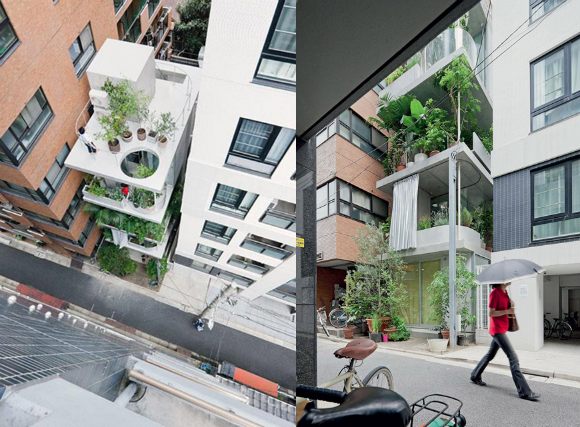
This innovative approach in small space design may offer you some ideas with regards to green space in your apartment, especially for those of you that live in small spaces, with little room to expand, or live in multi leveled apartments, or have balconies, etc. Tokyo-based architect Ryue Nishizawa designed this multi-story house in the middle of the city.  It’s designed to give you the feeling of being outside, while you’re technically inside and even the walls are built with this in mind.

“House & Garden”, amounts to a series of stacked concrete floor slabs bordered with transparent railings and curtains; a four-storey dwelling which is enclosed with walls of household plants growing within pots. Large balconies (for Tokyo standards) and terraces push the main living space from the street. These outdoor areas are filled with pots and plants, making the home seem more like a vertical garden. The architect has also opted to use curtains on both the interior and exterior of the house to provide privacy and divide up the living space.

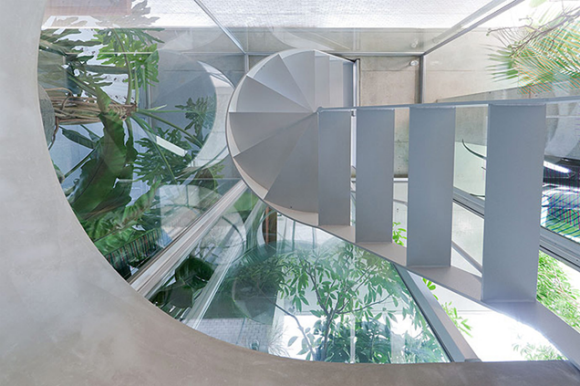
Staircases spiral up through the building, passing through circular openings in the thick concrete floor plates. A similar opening cuts through the roof, allowing taller plants to stretch through to the upper terrace. Bedrooms are located on the first and third floors and are separated from meeting and study areas with glass screens and curtains. For more images as well as drawings of the levels and the designed spaces, please visit here, here, or here.

07 January, 2013

Planted Terraces : an introduction

Since most of us live in cities, it is easy to understand the value of green. It is getting increasingly difficult to get in touch with nature, and most have to travel a bit farther to be in green surroundings. As the value of village life has diminished through the past fifty years, in the eyes of the modern consumer, we are experiencing nowadays an evermore increasing urge to be closer to nature ; for our eyes, for our senses to lay off the burden of concrete, its bareness and harshness to touch.

There are those lucky enough to be close to a park, forest or meadow. There are those that still live in villages or small towns, untouched by the modern urban madness that obliterates natural variation and numbs the sensory organs. There are those that live in cities friendlier to the human being. Quality of life is not easily attainable, and in most cases nowadays, comes with a higher price.

However, we still can largely define our closest environments. Do not neglect your home, and do not disassociate yourself from nature. If you have space, preferably outdoors, then use it to your advantage. Plant, nurture, grow living organisms, and they will reciprocate by giving you joy, fulfillment ; an oasis where you can retract and recharge your batteries. Being a roof, a terrace or a balcony, you can plant and make it green, to cater either for your daily needs for vegetables or herbs, or simply for pleasure.

The wealth of information out there, with regards to how you may "terraform" your urban environments, is trully astonishing. The question is sometimes, why so few of us ever do it. Give it a try, even for as simple a solution as having a number of planted pots and containers, and you will see after some time the real strength of my argument.

Here are some examples as what you could do, if you put your mind into it (and go rather large scale). There are intended for inspiration and motivation.

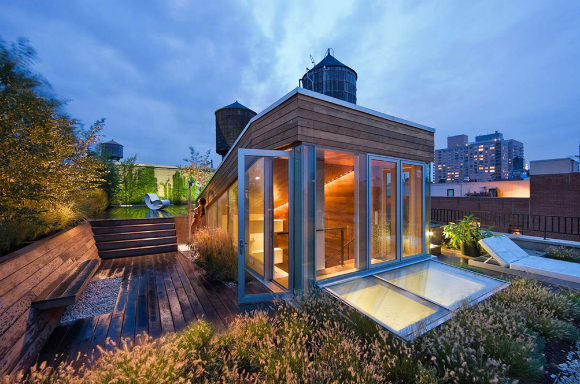
This sleek penthouse located in Manhattan was designed by Joel Sanders Architecture

Even the smallest bit of outdoor space can be one of the most covetable features of any Manhattan apartment. So how about over 1,600 square feet of lush, private outdoor space!?
A rooftop apartment in Bayswater, London, with its external areas designed by Philip Nixon design.

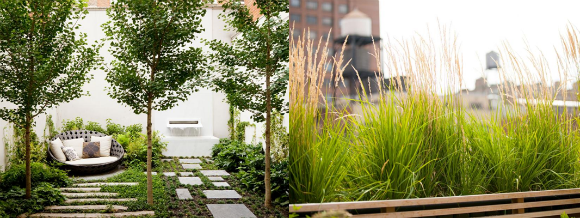
Carnegie Hill House in New York City, designed by Nelson Byrd Woltz Landscape Architects. The first floor garden is experienced as a diptych composition framed by ginkgos. To the left, locust slabs lead to a nest-like reading nook. The stone pavers carry the interior flooring into the garden and lead to a re-circulating fountain. Native grasses planted at the street edge of the 7th floor terrace provide a translucent screen between the private terrace space and the urban environment beyond.

08 November, 2012

Herb garden oasis

Swedish interior designer Susan Larsson plants her balcony garden each summer in Malmo. In the past Larsson has planted mostly fig and olive trees, but this time focused on kitchen herbs. Galvanized steel pots were used in this simple setup, together with wood & metal stools. A very handy set up for small spaces, or areas outside a kitchen.

Galvanized pots are made from treated metal to prevent rust. Since they are light and absorb heat easily, they are more suitable for plants grown in the shade or indoors. Depending on the design, these unique pots give a refreshing workshop look suited for cottage garden or a modern balcony garden. If the pots you have selected don't have drainage holes, then make some on their bottoms, using a large (for woodwork) nail and a hammer.

welcome dear reader.

blank

What you are browsing through is the initial form of a gazette, realised at this stage by a collection of posts brought together, from various fields & selected topics, aiming towards your entertainment and information. Some are own generated, others are processed re-ups from the blogosphere. Please feel free to browse, read, and distribute the content here.

blank

If you find what you read here as interesting, entertaining or thought-provocative, please tell it to your friends. New readers are always welcome. If you have copyright claims, please let us know, and we will amend accordingly.

blank

Images presented herein, are the property of their originators, unless stated otherwise. The METRONOME gazette wishes to declare that to the best of its knowledge, all photos and information presented in this website are true and valid, however it carries no responsibility as to the accuracy of the depictions, or wording of the posts, that are not of its own origination.

blank

Please do not hesitate to contact us with any inquiry or question you may have. See the Contact details section.
  

blank

about

blank

contact

blank

editorial

blank

theNEWSroom

blank

theMAGAZINErack

blank

DIY projects

blank

GAMESZONE

blank

GoingOUT

blank

Food4Thought

blank

PROJECTS

blank

blank

blank