15 November, 2013

now you can become a Whiskey Blender

Whisky Blender is an online store based in Scotland, operated by Drew Nicolson and Andy Davidson with the aid of Master of Malt John Lamond. The company has stocks of seven whiskys (some single malts, others blended), which you mix and match to develop your own customized blend, 10 ml at a time. The catch is that you only have Lamond’s tasting notes to go on, and these are all both fanciful and delicious-sounding. [1]

“Pick one of the seven whiskys and go heavy on that,” using it for up to half the bottle. “Trust your instincts and don’t overthink it. And don’t be afraid of making something bad.” If you’re not thrilled with your whisky at first, drink a bit, then put it back on the shelf for a few weeks. A bit of air in the bottle plus some time will help the different spirits to marry, and Whisky Blender says your first dram from the bottle will likely be significantly different than the last. Whether they use two whiskys or seven, “Most people are so amazed,” says Nicolson, with what they end up creating. It’s all a question of approach. “Some people want to make a budget version of Johnnie Walker Blue Label, but we try to convince them to create something of their own.” [1]

14 October, 2013

the Cocktail Society’s video guides

The definition of a cocktail goes back a couple of hundred years, which when it comes to the history of alcoholic beverages would be considered fairly young. Its name is disputed among liquid historians but what we do know is that it pretty much was one single drink from the “beginning” that later on evolved into being a concept for drinks mixed, shaken or even thrown. We do know that taverns, inns, public-drinking houses, pubs, ale houses and tap rooms were all serving intoxicating beverages from the 1000's and the 1700's but the cocktail as a phenomenon took form during the late 1700's and reached new heights during the Victorian era where glassware and tools for the bartender were developed. Furthermore, the invention of the refrigeration system and later on versions that produced ice contributed to the spreading of mixed drinks. [1]

Cocktail Society is a digital drinks hub run by Pernod Ricard Nordic and content provided by bartending experts from Purfict. Pernod Ricard Nordic is a cluster within Pernod Ricard, the world’s co-leader in wines and spirits. Pernod Ricard focuses on premiumisation and innovation of the 18 international key brands such as ABSOLUT, Jameson, Havana Club, Martell and Jacob’s Creek. Purfict has operated with training, media and conceptualization in the alcohol industry since 2008, driving cocktail culture towards positive development and premium quality standards.


Purfict has gathered experience by spending endless hours behind cocktail bars in Stockholm, London and New York since the late 90's. For the full list of guides on mixing fashionable cocktails, and preparing cocktails’ essentials, go here. Check out their blog here.

01 October, 2013

Brewing machines for the home brewer

Brewbot is a smart brewing appliance that you can control and monitor with your smartphone. Never brewed? No problem. Brewbot’s goal was to make an easy-to-use, controlled environment that is aesthetically pleasing, and frees up brewers to focus on the recipes. You don't need to know anything about brewing. You are guided through the process from beginning to end. Cargo, a multidisciplinary team of designers and developers based in Belfast, Ireland, have created this smart brewing appliance. However, the name chosen is somewhat a commonality, since designers, engineers and amateur brewers have constructed brew robots before, and in more cases a lot more sophisticated or more robust (in terms of brew process control and monitoring). Do a simple Google search with the term “brewbot” and you’ll see what I mean. Nevertheless this Brewbot is definitely more stylish. Check out their Kickstarter campaign, here.

The Brewbot system uses temperature sensors, load sensors, and flow meters to ensure users understand what is happening from start to finish. these sensors assist with the automation. Brewbot communicates with iPhones via bluetooth, supplying all the required feedback needed – from adding the grain on brew day, to how long you have to wait for the brew to ferment. In terms of production numbers, the appliance can brew up to 20 litres (or just over 5 gallons) of beer per batch.


Now off to the other side of the world. It has taken New Zealand start-up WilliamsWarn six years to get to the point of actually supplying commercial units, following the dream of creating a world-first : a micro-brewery to revolutionise home brewing. The truth is that at large they have succeeded. More than 800 people are on the waiting list for one or more of the micro-breweries, including 180 New Zealanders. That has been growing at around 100 a month since June 2012 when a brewer using a WilliamsWarn first-generation machine won the gold medal for his Pilsner at the Asian Beer Awards.


Users spend about 90 minutes cleaning and sterilizing the system, and adding supplied ingredients at the beginning of the process. After that, minimal input is required until a week later, at which point 23 liters (6 U.S. gallons) of beer should be ready for drinking. Part of the reason that it's able to make beer so quickly is the fact that the carbonation and fermentation processes take place simultaneously. The clarification process is also said to take no more than one day. The WilliamsWarn brewing machine sells for around 4,5k USD, and the ingredients for each batch of beer would set you back around 30 USD.

12 July, 2013

experimenting with beer

Erica Shea and Stephen Valand, started the Brooklyn Brew Shop out of the Brooklyn Flea in the summer of 2009 to get space-strapped New Yorkers brewing. With the idea that making beer (real beer from real ingredients) can be simple, tasty, and most important, fun, the Brooklyn Brew Shop created stylish, easy-to-use Beer Making Kits designed especially for stove-top brewing and ingredient mixes for seasonally inspired beers. In their own words : "Our goal is to get everyone brewing by simplifying the beer making process without dumbing it down."

The whole concept spans the entire brew process, with concise instructional videos that guide the prospective brewers through the whole process, from the actual unpacking of the kit, to filling bottles with the finished beer. Making beer consists of a few steps, none of which are hard, but since you're bound to have some questions, apart from the videos to watch, there is also a Q&A section available on their site, to answer most of your questins. Go here for more.


Do NOT forget, homemade beer tastes great, and it is something that YOU have created. However, a lot goes on while beer is fermenting. Your beer is becoming alcohol before your very eyes. It will change over time, and it might not even look like beer for a few days. So don't worry if your beer looks cloudy. Everything will settle to the bottom. Don't worry if your beer looks green for the first few hours. Hops are green, and they will settle to the bottom. In the end, don't worry. Beer will be beer.

For all available instructional videos, please go here. There is an extensive review of their beer making kit and brew process in three parts here (I), here (II) and here (III).

03 July, 2013

Highland Park rare whisky drinks cabinet

Cabinetmaker, craftsman and furniture artist John Galvin brings with him over ten years of experience in the design field. Originally from Ireland John has always had a real passion for quality design. Now located in Glasgow's west end John Galvin specialises in the application of traditional cabinet making methods to design unique pieces of bespoke furniture that will intrigue and captivate. The Highland Park drinks' cabinet was successfully launched at Design Junction in 2012 as part of London Design Festival and will be making appearances at some key design shows around the world.

The drinks cabinet, designed exclusively to house, and safeguard, their Orcadian Vintage Range. The exterior of the piece is hand crafted in beautiful American Black Walnut with a surprising Purple Heart interior creating a naturally eye catching glow. It is the attention to detail and craftsmanship which really makes this piece stand out, especially its interior. Once you open the two walnut doors you are immediately hit by the staggering Purple Heart wood. The doors also have shelves with leather detailing to hold six whiskey tumblers.

You then move onto the pull out glass shelf which acts as the drinks preparation area. Above this are the four drawers (two of which are circular) and a secret compartment for the custom made knife and chopping board. No classic drinks cabinet would be complete without a removable humidor which can be found in the centre of the piece. Below the Purple Heart interior are two large solid walnut drawers incorporating a dovetail construction. At the top of the cabinet is a glass folding door, behind which the Orcadian Vintages are beautifully presented in bespoke, bell-bottomed, jet black glass bottles. The folding door houses a clever locking system which can only be opened once the middle section of the cabinet has been unlocked.

03 April, 2013

prohibition kit by Francesco Morackini

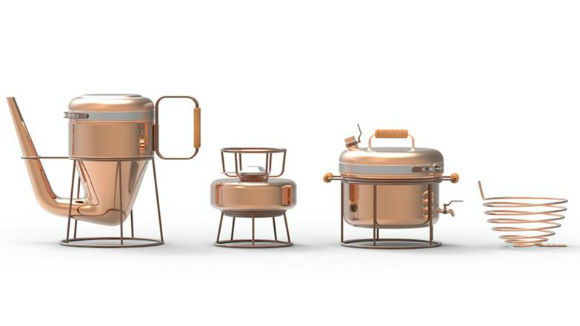
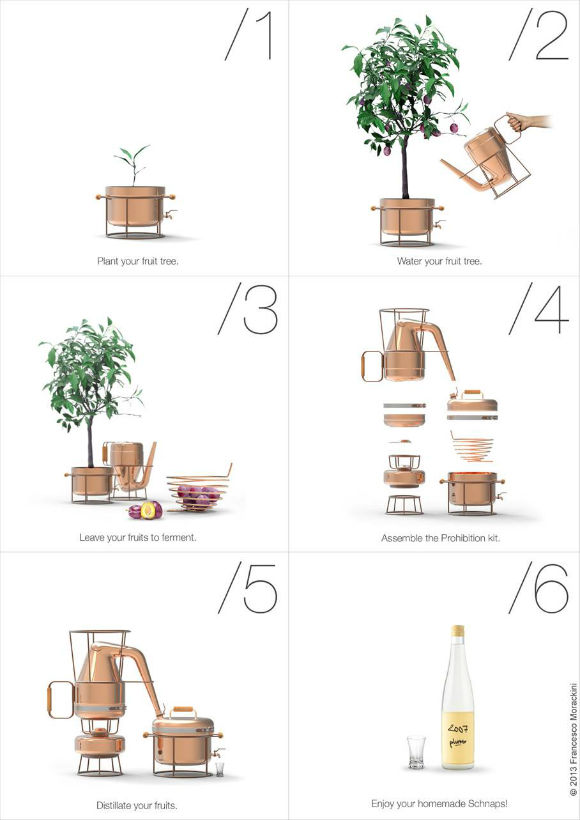
Distilling alcohol without a license is illegal in most countries in the world. However, many countries allow for the non-commercial brewing of a limited quantity of beer, wine, and mead in a process commonly known as homebrewing. While homebrewing is a hobby for many people across the globe, it is primarily carried out by poor people in developing nations as a cheap alternative to buying commercial alcohol, not to mention it is often stronger. This liquor-distilling kit by Vienna designer Francesco Morackini breaks down into four perfectly innocent household objects.
In the words of the designer himself : "I wanted to redesign a tool with a long tradition, and use copper not for a decoration purpose but for its inner quality. This material has always been used for the construction of stills since ancient times. With the evolution of time and technologies new materials have been introduced such as stainless steel. However, old Europe will by no means exchange their copper stills."


Francesco Morackini, born in 1980, studied industrial design and management then worked in Brazil, the United States and France before establishing his studio in Vienna. He creates objects, sometimes virtual, sometimes not. His work is about offering another point of view to observe the products surrounding us. Check out his "Dildo Maker", where in an interesting spin, he takes the iconic Loewy pencil sharpener, to a new use as a universal dildo maker. See it here.

27 March, 2013

Black Cow vodka

Vodka (Polish: wĂłdka, Russian: водка) is a distilled beverage composed primarily of water and ethanol, sometimes with traces of impurities and flavorings. Vodka is made by the distillation of fermented substances such as grains, potatoes, or sometimes fruits or sugar. [1] Basically they can be distilled from anything that can be fermented and finely distilled. Black Cow vodka is distilled not from potatoes but from cowsmilk. Created by Jason Barber - a farmer from Childhay Manor, West Dorset - the vodka, much to many drinkers’ delight, looks and tastes like the real deal. The process involves the milk being split into curds and whey. While the curds are used to produce the farm's award-winning Barber's 1833 vintage reserve Cheddar, the whey is fermented and distilled to create the clear, creamy vodka. [2]

In the world there are various alcoholic drinks that are produced by fermenting milk and dairy products. One originates from Tuva, a Siberian tribe, who use the milk from their mares to create the highly revered Araka vodka (and very difficult to find). Blaand was introduced to Scotland by Vikings. It is a fermented milk product made from whey (whey or milk serum is the liquid remaining after milk has been curdled and strained), and similar in alcohol content to wine. Kumiss, is a fermented dairy product traditionally made from mare's milk popular with the peoples of the Central Asian steppes. It is very similar to kefir.

Read a relevant tasting and review of the vodka here.

10 March, 2013

the Vaportini inhaler

This is the story behind the Vaportini, as presented by its inventor, at the official website. Restaurateur Julie Palmer, in Chicago, came up with the idea after visiting a friend. In her words : “A few years ago, I was visiting a friend in Helsinki. I was there during the Winter Solstice (the Season of Ghosts); he shared with me an unconfirmed tradition that happens on that date. We headed to his outdoor sauna with a group of friends and a bottle of vodka, he poured the vodka over the coals and we breathed in the vapors until we were sufficiently inebriated.”

When Palmer returned home, she wanted to re-create that experience at Red Kiva. By enlisting the help of her engineer father, she started experimenting with a few designs. until settling on a simple setup : a hand-blown glass globe with a candle underneath it. A shot of spirit sits in the globe, and as it heats up, the liquid evaporates and fills the sphere with flavorful and intoxicating vapors, which you can then inhale through a glass straw.

The inhaled alcohol together with the aromas and flavors, goes into your bloodstream, having more direct effects when compared to traditional drinking. It also does not last for the same duration, nor it has the same alcohol absorption cycle. You see, to describe it in a simple form, when consuming alcoholic drinks, the alcohol gets into you and basically generates its results via two ways, liquid and vapors. The vapors from the liquid in your stomach aim for your brain, while the liquid the rest of you. Since the liquid remains longer in you, until it is processed, the effects are more prolonged, and more widespread (in terms of organ utilization).

It only seems logical that this novel way of alcohol consumption, should not be as heavy on the stomach, liver and kidneys, as the traditional down-the-mouth way. My reservations of course are for the lungs. Since you are inhaling the stuff, I guess (plain common sense, and basic knowledge ; no science involved to prove or disprove) that more than half of its vapors, should end up in the lungs, and there absorbed into the bloodstream. Secondly, I do perceive that you need to inhale large quantities, in order to get even a mild buzz. That is not cost-effective, or efficient with regards to resources utilization (ie. the booze). Needless to mention of course, that for a drinker, consuming alcohol is a three-fold ritual which involves sight, smell and palate satisfaction (well four, if you count in the brain effects).

Read a first impressions article here. If you are interested to read more of the story behind the Vaportini, go here. For instructions of use, go here.

17 January, 2013

Absinthe explore kits

It is now possible to sample the most prestigious absinthes and make them available to a larger number of people, thanks to Absinthe Explore a sampling system which will allow you to discover the great richness of absinthes produced worldwide and their aromatic palette. Absinthe, a German company has made available this fully customisable kit, since there is the possibility to compose your own selection and taste the absinthes you wish to discover.

Each glass tube is hermetically sealed and contains 50ml, that it to say, the ideal measure for the preparation of a couple of absinthe glasses. Moreover, the Absinthe Explore packaging guarantees a near-total absence of oxygen during the conservation phase. The flavours are trapped in the tube and will only be released in your mouth. The absinthes that the collection offers are chosen with meticulous care out of the most prestigious firms.

20 December, 2012

Tumi mixology set

With a 30-year history of creating superior products for discerning professionals and frequent travelers, Tumi is recognized as the world's leading brand of luxury travel, business and lifestyle accessories. Tumi's success can be traced to its continual focus on its principles of design excellence, functional superiority and technical innovation.
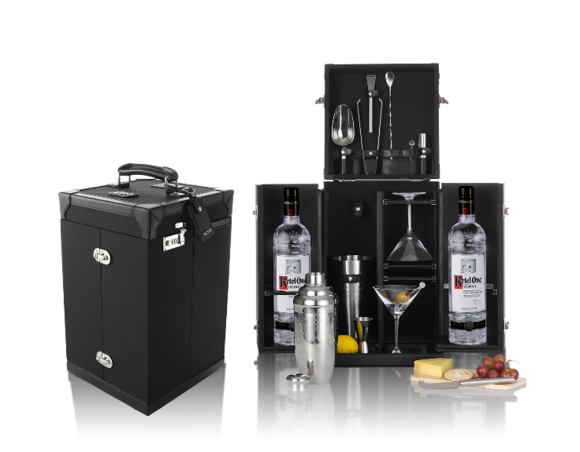
For this holiday season, Tumi has partnered with Ketel One vodka to release the Tumi Mixology Set, a limited edition case, beautifully crafted by hand in Italy, for the ultimate portable cocktail experience. On the other hand of course, this set would take you back approximately 4k USD, so its not a small gift either. The Nolet Distillery in Schiedam, Holland has been producing the highest quality spirits for ten generations. Ketel One Vodka is inspired by over 300 years of family distilling expertise.

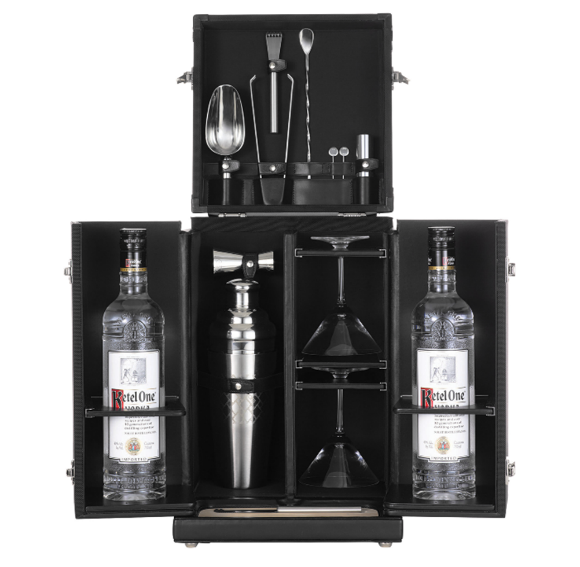
Eitherway, to quote from the supplier : " Every detail has been considered and exquisitely executed in this deluxe, special edition mixology set—, a uniquely sophisticated gift for those at the very top of your list. Handcrafted in Italy and covered in ballistic nylon with Italian leather trim and carry handle, this box case opens to reveal a complete bar set for those who travel in ultimate style. Inside there are places to hold two bottles and glasses. The set is stocked with the following accessories: removable shelves, coasters, cutting board and stainless steel shaker, ice scoop, tongs, measuring cup, stirrers and twist peeler. This limited edition piece leather detailing inside and out, dual hinges, front latches and dial locks on both sides of the case." 

If you wish to buy the set, here is where you will find it.

04 December, 2012

Craft a mojito like an artist

Most cocktail aficionados know how to make a Mojito, but after watching the video below, you will know how to make the perfect one. Laurent Greco shows us how to combine limes, mint, rum, bitters and Perrier in order to make this refreshing libation. A great basic for any bar, follow this step by step guide to mix up this all-seasons drink.


:) well, this is not the video, and that was definitely not Greco, but I really liked that one so I put it on. I wouldn't recommend following it either, since it uses white sugar and white rum in the mix, that basically results to a flat taste. The actual video that goes with the ingredients and the preparation instructions, is at the bottom.  

.ingredients .preparation & presentation
1/2 fresh lime squeezed Place the mint leaves in an absinthe glass
12 mint leaves Extract the juice of 1/2 fresh lime
2cl sugar cane syrup Gently muddle the ingredients
4 cl dark aged rum Add 2cl of sugar cane syrup and 3 dashes of bitters
Perrier Fill the glass with crushed ice
Pour 4 cl of dark aged rum
Stir well
Top up with Perrier
Add a dome of crushed ice
Place two straws
Add two stems of mint


welcome dear reader.

blank

What you are browsing through is the initial form of a gazette, realised at this stage by a collection of posts brought together, from various fields & selected topics, aiming towards your entertainment and information. Some are own generated, others are processed re-ups from the blogosphere. Please feel free to browse, read, and distribute the content here.

blank

If you find what you read here as interesting, entertaining or thought-provocative, please tell it to your friends. New readers are always welcome. If you have copyright claims, please let us know, and we will amend accordingly.

blank

Images presented herein, are the property of their originators, unless stated otherwise. The METRONOME gazette wishes to declare that to the best of its knowledge, all photos and information presented in this website are true and valid, however it carries no responsibility as to the accuracy of the depictions, or wording of the posts, that are not of its own origination.

blank

Please do not hesitate to contact us with any inquiry or question you may have. See the Contact details section.
  

blank

about

blank

contact

blank

editorial

blank

theNEWSroom

blank

theMAGAZINErack

blank

DIY projects

blank

GAMESZONE

blank

GoingOUT

blank

Food4Thought

blank

PROJECTS

blank

blank

blank